A pile of drywall and lumber does not just clutter a job site. It can quietly eat into your schedule, your budget, and your next subcontractor's start date.
Construction debris removal is one of the most overlooked line items on a renovation or build. Contractors often only notice its true cost after a deadline has already slipped.
Fixed project costs keep running whether the job site is clean or not, and every day debris sits untouched is a day those costs compound.
This article walks through what proper debris removal covers, what to look for in a provider, and how a same-day service changes the math on your next project.
Need construction debris removed now?
GoGo Junk Removal handles construction and renovation waste across Metro Atlanta with same-day availability.
View Construction Debris Removal Service →What Construction Debris Removal Actually Involves
Construction debris removal is not the same as a general junk haul. It covers the specific waste generated during a build, remodel, or teardown, and it needs to leave the site in a way that keeps you compliant with local disposal rules.
What a Debris Removal Pickup Covers
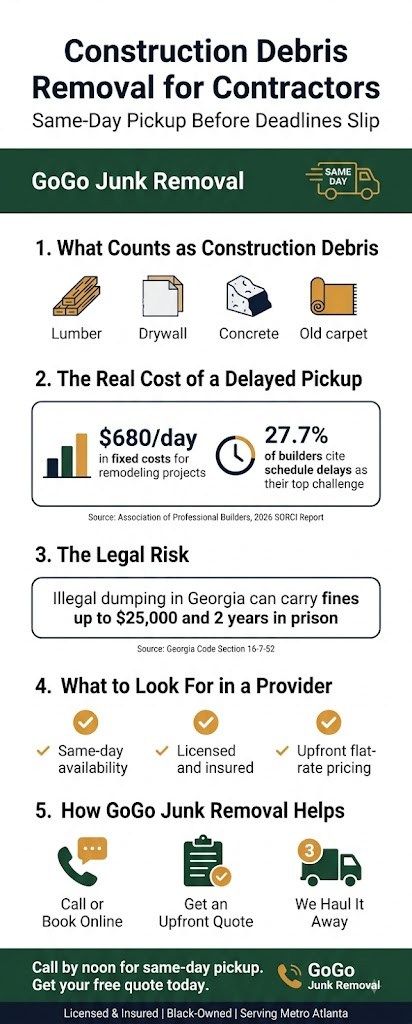
A proper pickup clears lumber, drywall, concrete, old carpet, fixtures, and general renovation waste from the site in a single trip or a series of scheduled trips.
This includes materials pulled during framing, drywall installation, flooring replacement, and finish work.
Georgia's solid waste rules require this material to go to a permitted construction and demolition landfill, not informal disposal. (Georgia Comprehensive Rules 391-3-4, Solid Waste Management)
Where Contractors Get the Timing Wrong
Most contractors treat debris removal as a cleanup step scheduled after the job is finished. That approach works until debris piles block access for the next crew or an inspector flags the site for improper storage.
Scheduling pickups at each phase transition solves this, rather than waiting for the final walkthrough.
What to Look for in a Debris Removal Provider
Not every hauler is equipped to handle a construction site on a contractor's schedule. Three factors separate a provider who protects your timeline from one who adds another delay to it.
Same-Day and Next-Day Availability
A provider who can only schedule a week out does not help when a debris pile is blocking Thursday's inspection. Same-day and next-day availability, with a clear cutoff time for booking, is the baseline requirement for any contractor working against a deadline.
Licensed and Insured Status
Georgia law treats unauthorized waste dumping as a criminal matter, not a minor infraction.
Georgia law treats unlawful dumping of more than 500 pounds or more than 100 cubic feet of certain nonhazardous, noncommercial waste as a misdemeanor for a first offense and a felony for a second or subsequent offense.
A repeat offense can carry a fine of up to $25,000 and imprisonment for up to five years under Georgia Code § 16-7-53.
A licensed and insured hauler carries the accountability for proper disposal, so the liability does not land back on the property owner or general contractor.
What a Delayed Pickup Actually Costs You
Most junk removal content stops at listing accepted materials. What it skips is the actual price of letting debris sit.
$680
per day in fixed costs for remodeling projects
$573
per day in fixed costs for new home builds
of builders cite subcontractor and schedule delays as their top challenge
That money is spent whether or not the crew can work. A cluttered site also raises basic safety exposure.
Construction workers face a nonfatal fall, slip, and trip injury rate of 31.5 per 10,000 full-time workers, well above the 22.6 rate across all industries. (U.S. Bureau of Labor Statistics, 2024)
This is general construction injury data, not a debris-specific finding, but it supports the case for keeping a site clear. General liability coverage for a debris removal contractor runs about $138 a month on average. (Insureon, 2025)
Paying for reliable, insured pickup costs far less than absorbing a stalled schedule or an injury claim.
Managing a full commercial site or property cleanout?
GoGo handles commercial cleanouts for businesses, contractors, and property managers across Metro Atlanta.
Commercial Cleanout Services →How GoGo Junk Removal Handles the Job
Licensed and insured haulers in Georgia must hold valid business licenses and follow commercial vehicle registration and transportation rules before they can legally transport waste for hire. GoGo Junk Removal operates within that standard. The process is built around getting a site clear without adding a step to your day.
The Booking and Pickup Process
You can call or book online, and same-day appointments are available if you call by noon. The crew handles the loading and hauling once on site, so nobody on your team has to stop working to move debris themselves.
The crew quotes flat-rate pricing by load size upfront before loading begins, so there is no guessing at the final bill.
What Happens to the Debris
Before hiring any hauler, it is worth asking a few direct questions. Is the company licensed and insured? Will they provide proof before the job starts? How do they handle disposal once the truck is loaded?
GoGo routes usable materials to donation partners such as Goodwill and Habitat for Humanity ReStore where possible, and the crew diverts remaining recyclable material from the landfill instead of dumping it in bulk.
That answers the disposal question directly, rather than leaving it open after the truck pulls away.
Frequently Asked Questions
How fast can I get construction debris removed in Metro Atlanta?
Same-day pickup is available if you call by noon, and next-day appointments can be booked any time after that. This covers the full Metro Atlanta service area within a 25-mile radius of Decatur, Georgia.
How much does construction debris removal cost?
Pricing runs on a flat-rate, load-based structure — from a quarter load up to a full load — with the exact price confirmed before work begins. There are no hidden fees added after the truck is loaded.
Is it illegal to dump construction debris yourself in Georgia?
Yes, in most cases. Georgia Code Section 16-7-43 makes unauthorized dumping on public or private property unlawful, and larger-scale violations under Georgia Code Section 16-7-52 can carry felony penalties. Using a licensed hauler removes that legal exposure from the property owner or contractor.
Does GoGo Junk Removal recycle construction materials?
Yes. GoGo donates usable items to organizations like Goodwill and Habitat for Humanity ReStore, and the crew routes recyclable materials through proper recycling channels instead of a landfill wherever possible.